

I have all the longevity genes according to 23andme, a dubious outfit which originally informed me I had the double APOE4 allele which meant I was 1200 times more likely to develop Alzheimers which, predictably, scared the pants off me. So I went on a two year research trip, happening upon Dale Bredesen, who seems to have cracked the case nutritionally, if you start early enough, which I did. It meant a lot of cognitive supplements, like Lions Mane which has NGF (nerve growth factor), the discovery of which gave the scientist, Rita Levi-Montacini the Nobel, and she was working in her lab until her death at 93. A lot of other supplements, plus fasting, no sugar, plus meditation which I did anyway.
If you can live to 2030 say longevity scientists, you will live another 20. By 2050, another 50.
Then 23andme informed me they were wrong, that in fact I had the allele that cancelled any danger from the one scary APOE4 allele.
All to say longevity is a slippery field, but on my matrilineal line, Irish bog dwellers back to the year dot I like to think, the women live forever. My grandmother went into the hospital at the age of 97 for the last time. Her smaller suitcase burst open and supplement bottles spilled out. “Was your mother sick all the time,” asked the nurse.
“Yes,” said my mother. “Those old ladies go on forever,” the nurse replied.
We all have low body temp, very low blood pressure, age very very slowly, and are disgustingly sensitive to our environments, which indicates to me many generations experiencing periodic starvation.
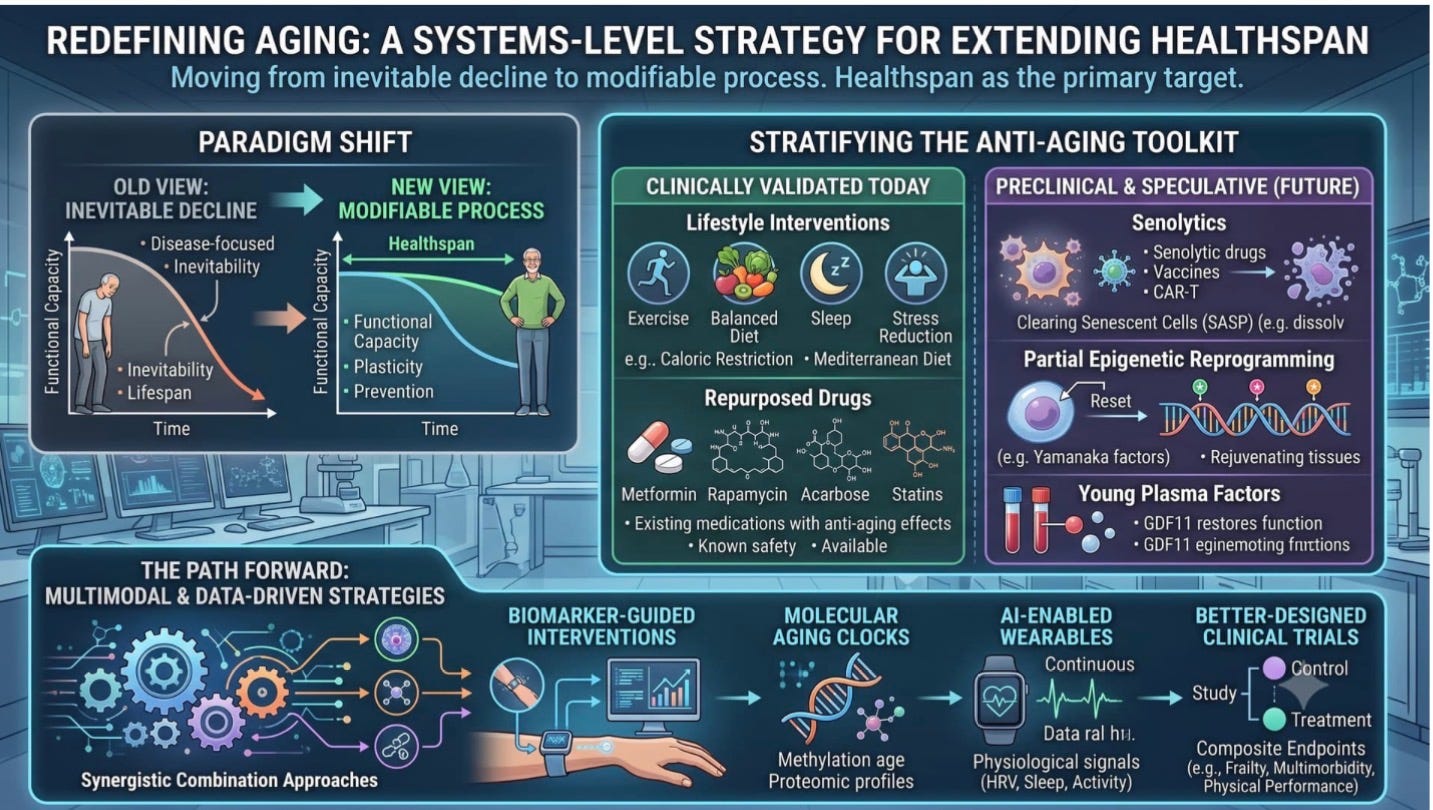
Which is one of the pathways to extreme anti-aging. In fact, Aubrey de Grey’s institute, LEV Foundation, concentrates on ridding the body of cellular and intracellular debris, otherwise known as senescent cells, one of the seven pathways of aging. Fasting, which DeGrey practices, is a natural senescent, and one oncologist, Dr. Katie Demming, recently quit her practice to run fasting clinics for cancer patients, saying she could not tolerate poisoning people any longer. Her success rate is high.
My own history is one of perpetual illness, mostly because I override my physiology - “engine too big for her chassis” said my father - which developed to the point where during my peak “career” years, I was sick for ten days out of 2 months. A liability which resulted after a particularly active time recently, in two years lying prone. I estimate overall 8 years in bed. Reading. And then studying various interests in some depth - in end a positive result. Those final two years of study were transformative. I built myself a new body which now climbs mountains in the snow, swims in the northern Pacific Ocean, March-December, and never gets sick. I am in awe of it.
I used mostly herbs and some pharma and worked with a naturopath and the emergency room. Free healthcare meant I didn’t have a GP for four years, so that’s what was on offer. I also read a book by Dr. Sandra Kaufmann, a pediatric surgeon with an advanced degree in herbal medicine. She’s cracked the code on ‘health span’, in my opinion, and if you put her work up against that of every lab and science institute now studying longevity, I betcha they would find solutions.
That’s not what this is about. Longevity is a hard science. If you can live to 2030 say longevity doctors and researchers, you will live another 20. By then, another 20 will be on offer. And by 2060 say, at the latest, we will reach Aubrey de Grey’s Longevity Escape Velocity, and you are looking at a few hundred years. Or forever.
“People fear bringing aging under medical control because they are afraid to emotionally invest in the concept,” says De Grey
David Sinclair of Harvard says the same. Often. So do promoters like Peter Diamandis, who marshals the worried well investor class annually to visit the labs where admittedly astonishing work is being done. This costs $80,000. I would love to do that, but it’s out of my range. Diamandes estimates longevity as a $32 trillion opportunity and all the digital oligarchs are heavily invested.
Barring elite class medicine, I have to wait for the public release of Yamanaka factors. They are in human trials right now, regenerating the optic nerve and retina. Yamanaka factors, the inventors of which received the Nobel in Medicine (still respectable) in 2006 can take a human cell, and reset it to pluripotent which is to say an all-powerful regenerative cell which can rejuvenate an organ, tissue, skin (in human trial) and even, they think, the brain.
There is apparently no quarrel among scientists that cells can be turned back to youthful status, while retaining memory of their original purpose.
Which means pancreatic beta cells, dopamine producing neurons, blood and immune cells, liver tissue, heart muscle cells and optic, retinal and skin cells can be reintroduced to the body and rejuvenate the specific organs in situ.
This is a miracle. This is everything. We are, say the hundreds of scientists working on this, five years away from the factors being available, depending on human trials, and the eye and skin trials are looking good.
Here’s a list of the most significant researchers in the field; their papers are easily accessible on PubMed or Science Direct. I list these because I am certain, at this juncture, you suspect quackery.
Jaco Pedro de Margalhaes
Steve Horvath - invented the epigenetic clock
Vadim Gladyshev - aging is plastic and reversible
Juan Carlos Belmute - cellular reprogramming
Matt Kaeberlein - pragmatist
Brian Kennedy:
These are the ‘Seven Hallmarks of Aging’.
Senescent cells.
Extra and intra cellular junk
Mitochondrial mutations
Stem cell depletion
Genomic instability
Impaired autophagy
Chronic inflammation
The four Yamanaka factors are:
OCT4
SOX2
KLF4
C-Myc
Collectively known as OSKM
Remember these, because they may save your life.
The last, C-Myc was dropped recently because it was shown to increase the risk of cancer, which as you imagine is the risk with pluripotent cells. The ‘clock’ has to be sharply calibrated. But, as Nature reported this year, OSK was the first to make damaged cells in the human eye biologically younger.
Steve Horvath, above, invented a clock that can estimate the age of various human tissues, which makes rejuvenation measurable. I repeat this because it is so significant.
Replacement of organs is the second strand of this story, the third being the clearing out of senescent cells, which they call extra and intra-cellular junk. This latter, debris removal, is the concern of Aubrey de Grey’s LEV (Longevity Escape Velocity) Institute, where he test thousands of mice. As stated above, De Grey recently affirmed after 2025’s trials, that one bullet is not enough, stopping age related decline is a multi-factorial effort. Pharma’s aim is always the single bullet, a blind spot which I hope they can clear.
One of the disputes tarnishing longevity is the failure of resveratrol, developed by David Sinclair’s lab at Harvard and the source of the ‘red wine is good for you’ fiction. His process was bought for $720 million by GlaxoSmithKline and failed; the charges of fraud were noisy. But Sinclair still takes 1000 mgs of resveratrol every day, and I suspect that in combination with fasting, exercise, a low sugar diet, and other supportive supplements, resveratrol is still a powerful anti-aging tool. Magic bullets, there are not. Sinclair is always in the news, and takes the heat of disbelief and mockery well. Most researchers and companies fly well under the radar. You can read about some of the most interesting in some detail here.
We even have advanced to the establishment of standards for mitochondrial transfer and replacement. Any engineer reading this will understand its significance.
Becoming, a research lab which came out of stealth mode this year, is certain that they have invented the first activation of developmental intelligence allowing placental invasion. They know how the baby’s blood system attaches to the mother’s, and they know just how to tinker with that child’s genetic liabilities.

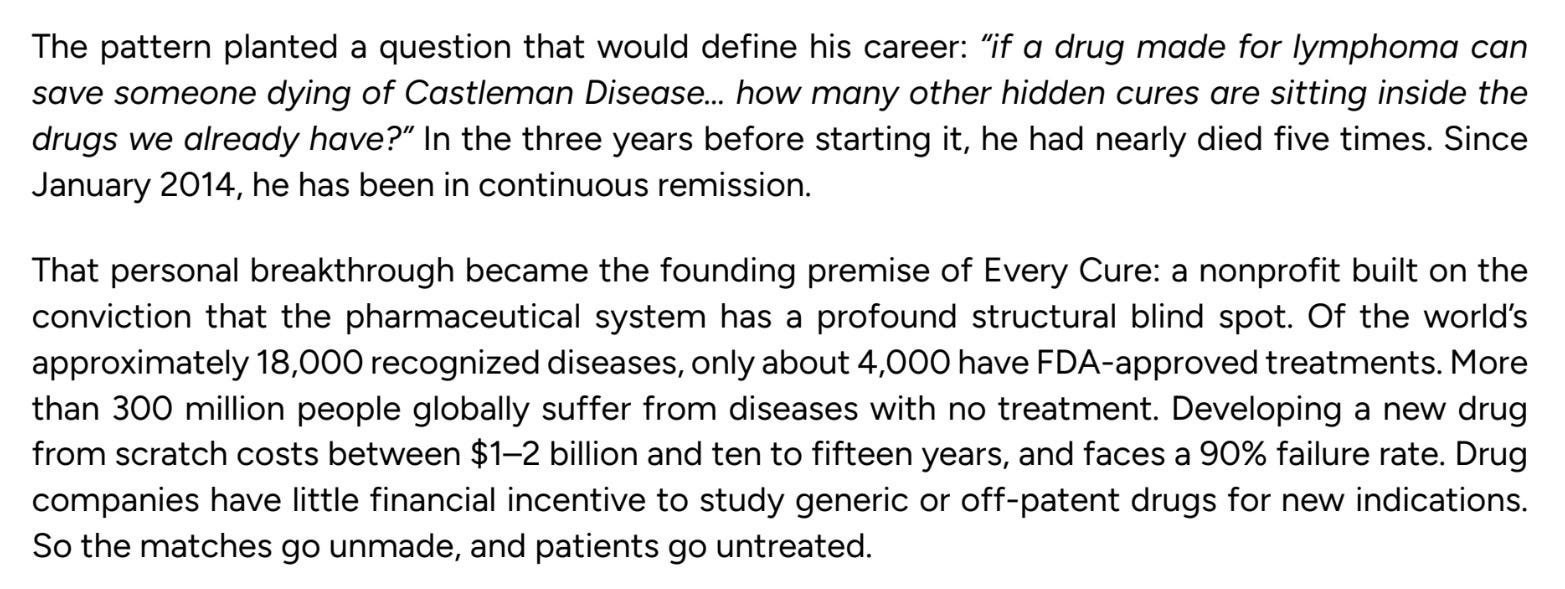
AI has led scientists to believe that many of the drugs already invented can be repurposed to treat on an individual basis, which is to say, that using our DNA, and the developed illness, narrow targeting is possible. For instance, this kid, David Fajgenbaum, a 25 year old med student with an incurable disease, Castleman, has been kept alive by a series of chemo drugs repurposed. Which bore fruit with Fajgenbaum’s non profit, Every Cure.
All this is AI powered:

Which means intelligence is compounding across every metric.
The implications of this are system-changing. We need more active mature adults in our culture, badly, I would argue. It will change entire patterns of life, including and especially child-bearing. It will solve the birth gap: the demographics of which are indeed dire, when it comes to the intelligent and competent. We, they, think fallopian tubes and ovaries can be regenerated, so that the choice to have children for the ambitious is not a Hobson’s Choice, bestowing endless uncertainty and unhappiness. Musk said recently that in ten years, we won’t need money, we will have anything we want or need. “The Treasury Department”, he said, “could just write everyone a check.” Stop laughing, the guy has no counterpart in history.
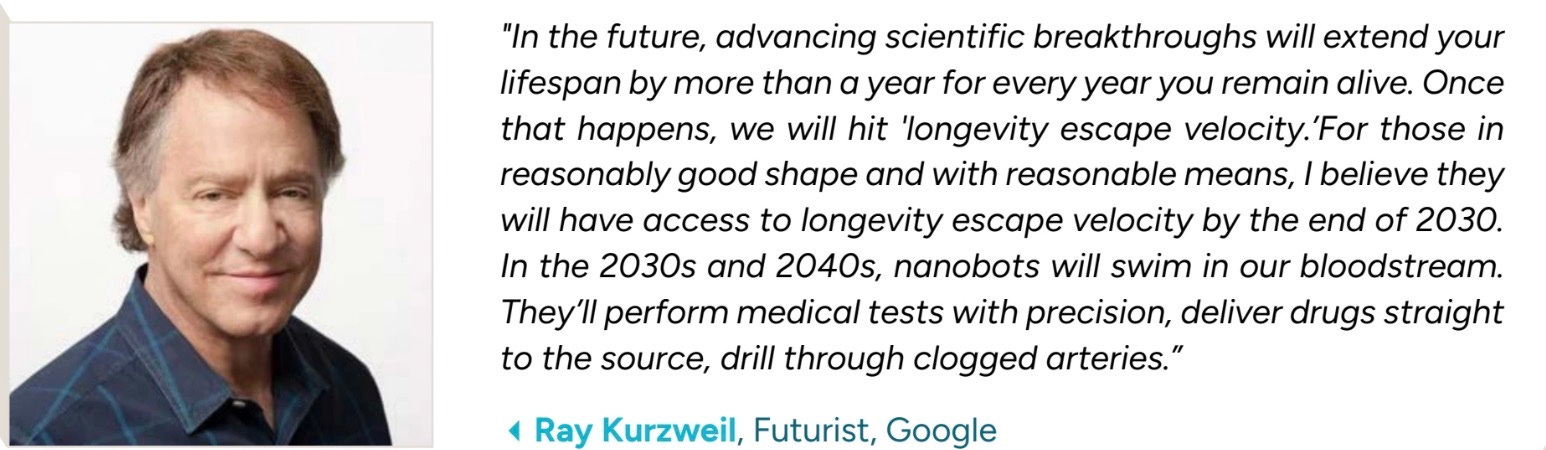
In the meantime, there are all the life extension and health extension plans that do work. I fumbled through the dark to find that in fact, I use what both David Sinclair and Aubrey de Grey use. I wore trackers for ten years, but now, it’s just intuitive - fasting, exercise, stressing body and mind while (vile phrase) listening to my body. I take the supplements both men take, to my surprise, but in fact, these modalities are common knowledge. I haven’t even touched rapamycin, which I suspect everyone is secretly on; but I found myself about to buy some from India recently.
Brian Johnson is a cautionary tale, his regimen so over the top, his body has just said bloody hell, enough, and he’s developed a gastric immunological disease. The food he ate was so horrid, I don’t how he stood it. Hello? The body needs pleasure, not a daily whipping. Moderation in all things. Nevertheless, the race is definitely on, every future forward investor is up to his or her neck, including pretty much all of the glamorous names of the digital age, and there will be many crack-ups, miscalculations, bankruptcies, frauds, and deadly mistakes.
But think, what if you could de-age a couple of years for every year? What if you could, as some of the above scientists believe, just take a pill every year, and that would be that? What could you do with the massive, underutilized crystallized intelligence of a 60 year old and the body and energy of a 30 year old? What couldn’t you do? It’s an interesting thought experiment, and very happy-making frankly. Below you will find a list of 12 papers weighted towards rejuvenation and actual life extension, and all of these scientists have their ideas working out in labs right now.
Just five more years.
You have to subscribe here, on Substack to get the newsletter.
I do not paywall, so it’s voluntary to pay me. I charge not very much compared to others, because you must have a lot of other subscriptions, I know I do. Please subscribe, despite my worry above, the next ten years are going to be transformative and in a very good way. We are going to get them and punish them and it will be spectacular.
You can buy me a coffee here
or
for those who don’t hate paypal, paypal me here
or
Become a Founding member here
Elizabeth Nickson was trained as a reporter at the London bureau of Time Magazine. She became European Bureau Chief of LIFE magazine in its last years of monthly publication, and during that time, acquired the rights to Nelson Mandela’s memoir before he was released from Robben Island. She went on to write for Harper’s Magazine, the Guardian, the Observer, the Independent, the Sunday Telegraph, the Sunday Times Magazine, the Telegraph, the Globe and Mail and the National Post. Her first book The Monkey Puzzle Tree was an investigation of the CIA MKULTRA mind control program and was published by Bloomsbury and Knopf Canada. Her next book, Eco-Fascists,,How Radical Environmentalists Are Destroying Our Natural Heritage, was a look at how environmentalism, badly practiced, is destroying the rural economy and rural culture in the U.S. and all over the world. It was published by Adam Bellow at Harper Collins US. She is a Senior Fellow at the Frontier Center for Public Policy, fcpp.org. You can read in depth policy papers about various elements of the environmental junta here: https://independent.academia.edu/ElizabethNickson.
Her essay on the catastrophic failings of Canada’s CBC is included in Michael Walsh’s Against the Corporate Media, 42 Ways the Press Hates You, published in September 2024
This is a Chat GPT generated reading list that I’m parking here so as not to lose it.
Stage I: The conceptual foundations
1. López-Otín et al.,
“Hallmarks of Aging: An Expanding Universe”Cell, 2023
This is the updated map of the field: genomic instability, epigenetic alterations, mitochondrial dysfunction, senescence, stem-cell exhaustion, chronic inflammation, impaired autophagy and the other major drivers that interventions attempt to reverse.
The original 2013 paper is also worth keeping for comparison:
2. López-Otín et al., “The Hallmarks of Aging” Cell, 2013
This paper gave modern geroscience its basic intellectual architecture.
Stage II: The Yamanaka revolution
3. Takahashi and Yamanaka, “Induction of Pluripotent Stem Cells from Mouse Embryonic and Adult Fibroblast Cultures by Defined Factors.” Cell, 2006
The origin paper. Four transcription factors—Oct4, Sox2, Klf4 and c-Myc, or OSKM—converted differentiated mouse cells into induced pluripotent stem cells. This established that cellular identity is not permanently fixed.
4. Takahashi et al.,
“Induction of Pluripotent Stem Cells from Adult Human Fibroblasts by Defined Factors” Cell, 2007
The human demonstration. Adult human skin cells were returned to a pluripotent state using the same basic factor set.
Those two papers established full reprogramming. The subsequent challenge was:
Can we turn back cellular age without erasing what the cell is?
That is the birth of partial reprogramming.
Stage III: Partial reprogramming and rejuvenation
5. Ocampo et al.,
“In Vivo Amelioration of Age-Associated Hallmarks by Partial Reprogramming”. Cell, 2016
The foundational rejuvenation paper.
Researchers used cyclic OSKM expression rather than continuous expression. In a progeroid mouse model, partial reprogramming improved cellular and physiological hallmarks of aging without fully converting tissues into pluripotent cells.
This is where the field becomes directly relevant to extending life.
6. Lu et al.,
“Reprogramming to Recover Youthful Epigenetic Information and Restore Vision”, Nature, 2020
Using OSK without c-Myc, the researchers restored youthful methylation patterns, promoted optic-nerve regeneration and reversed vision loss in aged mice and a mouse model of glaucoma. The effects depended on the DNA-demethylating enzymes TET1 and TET2.
The startling implication is that cells may retain a recoverable record of their younger state.
This is also particularly relevant because the eye has become the first major clinical proving ground for partial reprogramming.
7. Roux et al.,
“Diverse Partial Reprogramming Strategies Restore Youthful Gene Expression and Transiently Reduce Biological Age Without Loss of Cellular Identity” Cell SystemS, 2022
An important comparison of different partial-reprogramming approaches. It asks which rejuvenating effects occur before cells lose their differentiated identity.
8. Cano Macip et al.,
“Gene Therapy-Mediated Partial Reprogramming Extends Lifespan and Reverses Age-Related Changes in Aged Mice” Cell Reprogramming, 2024
Aged mice treated with an inducible OSK gene therapy showed lifespan extension and reversal of several age-associated changes. It is exciting, although the paper comes from Rejuvenate Bio and needs independent replication.
9. Paine et al.,
“Partial Cellular Reprogramming: A Deep Dive into an Emerging Rejuvenation Technology”— 2024 review
This is probably the best bridge between the original experiments and the current field. It addresses delivery, dosing, cellular identity, tumour risk and the limits of the evidence.
10. Pereira et al.,
“Epigenetic Reprogramming as a Key to Reverse Ageing and Increase Longevity”— 2024 review
Good coverage of both transcription-factor reprogramming and possible chemical approaches to achieving related epigenetic effects.
11. Cipriano et al.,
“Mechanisms, Pathways and Strategies for Rejuvenation Through Epigenetic Reprogramming”— 2024 review
Especially useful for understanding the function of each reprogramming factor rather than treating OSKM as a mysterious cocktail.
Stage IV: How do we know a cell became younger?
12. Horvath,
“DNA Methylation Age of Human Tissues and Cell Types”
—
Genome Biology
, 2013
The classic epigenetic-clock paper. Horvath developed a clock capable of estimating age across numerous human tissues and cell types.
You need this to understand almost every later claim that an intervention has “reversed biological age.”
13. Levine et al.,
“An Epigenetic Biomarker of Aging for Lifespan and Healthspan” Aging, 2018
Introduced DNAm PhenoAge, which was designed to predict morbidity and mortality rather than merely reproduce chronological age.
A caution: a clock moving backwards does not automatically prove that the organism has been rejuvenated. A convincing intervention should also improve tissue function, resilience, disease burden or lifespan.
14. Lu et al.,
“Universal DNA Methylation Age Across Mammalian Tissues” Nature Aging, 2023
This work built clocks across many mammalian species and supports the idea that parts of epigenetic aging are evolutionarily conserved rather than random noise peculiar to humans.
Stage V: Senescent-cell removal
Partial reprogramming may restore damaged cellular programming. Senolytics pursue a different strategy: remove cells that have become dysfunctional and inflammatory.
15. Kirkland and Tchkonia,
“Senolytic Drugs: From Discovery to Translation” Journal of Internal Medicine, 2020
The best broad introduction to the senolytic field and its movement from animal experiments toward clinical trials.
16. Hickson et al.,
“Senolytics Decrease Senescent Cells in Humans” EBioMedicine, 2019
A tiny open-label study—only nine participants—but important because dasatinib plus quercetin reduced several markers of senescent-cell burden in human tissues. It does not establish that the combination extends human life.
17. Justice et al.,
“Senolytics in Idiopathic Pulmonary Fibrosis” EBioMedicine, 2019
Another small early human study suggesting feasibility and possible physical-function improvement. It is promising, not definitive.
Do not extrapolate these papers into self-treatment with dasatinib. It is a potent prescription cancer drug, and the human longevity evidence is nowhere near sufficient.
Stage VI: Mitochondrial replacement and repair
This field may eventually complement epigenetic reprogramming. Reprogrammed nuclear gene expression does not necessarily repair every mutation or defect in mitochondrial DNA.
18. Brestoff et al.,
“Recommendations for Mitochondria Transfer and Transplantation”— 2025 consensus statement
A useful, sober framework defining what mitochondrial transfer and transplantation actually mean and what standards the field needs.
19. Riou et al.,
“Mitochondrial Transplantation in Brain Disorders” Neuroscience & Biobehavioral Reviews, 2025
Covers the attempt to introduce healthy mitochondria into damaged cells, including potential neurological applications and the substantial delivery and sourcing problems that remain.
20. Deng et al.,
“Nanoengineered Mitochondria for Mitochondrial Therapeutics”— 2025
More futuristic: engineering and delivering mitochondria to cells
Dear Elizabeth, you left God out of your calculations.
My daddy lived to 100. He ate cookies and ice cream.
He walked everywhere, we walked in the woods, at the mall, all over the neighborhood.
Walking around is good.
He believed in God.
Mom lived to 94 and would have lived longer but she fell, broke her hip, had the surgery, got mrsa at the hospital, had a tantrum and said she wanted to go to Heaven. She wanted out of this revolting situation.
Are you sure you want to live to be 117 or ?? and live among crazy people?